Article: Sabyasachi Returns to New York Fashion Week: Is Indian Luxury Ready for the World Stage?
Sabyasachi Returns to New York Fashion Week: Is Indian Luxury Ready for the World Stage?
A designer who spent two decades building quietly returns to the international calendar with a Metropolitan Museum of Art partnership. The show is the easy part. The harder question is what comes after it.
There is a particular kind of silence around a designer who stops showing. For most of the last two decades, Sabyasachi Mukherjee has been absent from the international fashion calendar while becoming one of the most commercially powerful names in Indian fashion. No Paris debut, no seasonal New York appearance, no attempt to be validated by a system he was not part of. He built instead: stores, categories, a customer base, an aesthetic so specific it became shorthand for an idea of Indian luxury.
On 15 September 2026, that silence ends. Sabyasachi returns to the New York Fashion Week runway, appearing on the official CFDA calendar for the first time, closing out the season alongside Thom Browne. He arrives with a multi-year collaboration with The Metropolitan Museum of Art, opening with a high jewellery collection drawn from the museum's Byzantine holdings and handcrafted in India.
The interesting question is not whether the show will be beautiful. It almost certainly will be. It is what the moment signals about where Indian luxury actually stands, and what it would take for Indian brands to be treated not as a fascinating regional story but as a global category with its own authority.
Why a New York Show Still Means Something
Fashion weeks have been declared irrelevant for years, usually by people who still attend them. The truth is more specific. New York is not the most creatively adventurous of the four capitals, and it does not carry the institutional weight of Paris couture. What it has is commercial infrastructure: buyers, department stores, American press, the machinery that turns a collection into a distribution reality.
It also places the work inside a comparative frame, judged not against other Indian labels but against everything else on the calendar, by editors and buyers who did not grow up with the context that makes Indian craftsmanship legible.
That exposure is valuable and easy to overstate. International visibility and genuine global desirability are not the same thing, and Indian fashion has often confused them. Visibility is a red carpet appearance, a museum gala, a well-photographed front row. Desirability is a customer in Los Angeles or Dubai or Seoul choosing an Indian house over a European one, repeatedly, at full price, for reasons that have nothing to do with heritage tourism. The first can be bought. The second has to be built, and Sabyasachi's business suggests he knows the difference.

Image Source: Sabyasachi
The Quiet Build: How a Couture Label Became a Luxury House
Sabyasachi's early reputation rested on Indian couture and bridalwear, a category with unusual economics. Indian weddings generate enormous, emotionally driven spending, and a designer who captures that market gains a high-value customer who arrives at a specific life moment expecting the purchase to matter.
What he did with that position is the instructive part. Rather than staying a couture house, the brand expanded into jewellery, accessories, handbags, eyewear and a broader lifestyle language, with a flagship on Christopher Street in New York's West Village since 2022. Aditya Birla Fashion and Retail acquired a 51 per cent stake in 2021, and in August 2026 the business was restructured into a corporate entity, Sabyasachi India Limited, spanning apparel, beauty, jewellery and accessories.
The numbers indicate direction. The brand reported revenue of about 650 crore rupees in financial year 2026, with jewellery contributing roughly a third of turnover. Accessories are growing quickly, and the brand has said it intends to move into fragrance, footwear and small leather goods while scaling eyewear, a category it first developed through a collaboration with Morgenthal Frederics.
This is the architecture of a luxury house rather than a couture atelier: repeatable categories, year-round purchase occasions, an ecosystem that lets a customer enter at a pair of sunglasses and progress toward an heirloom. European maisons have run this playbook for a century. Very few Indian brands have attempted it seriously.
Craft as Capital
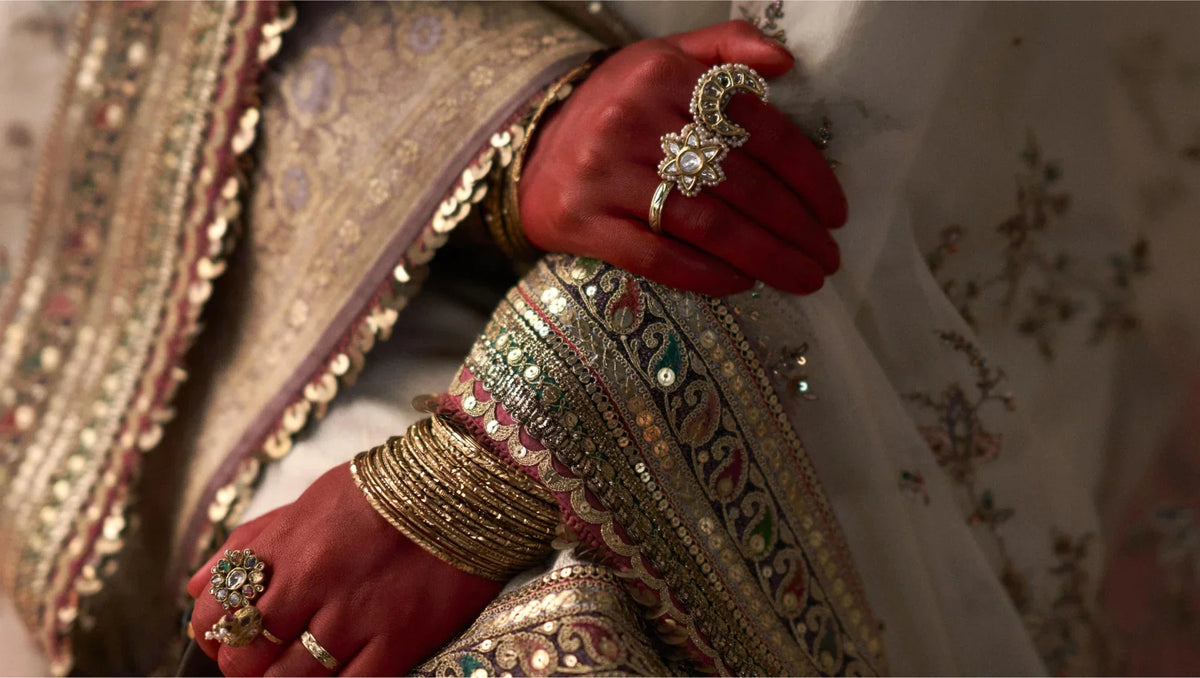
The strongest asset Indian luxury holds is also the most misunderstood. Banarasi silk, zari, aari and zardozi embroidery, kantha stitching, the polki and kundan jewellery traditions: these are not decorative flourishes but living technical systems, sustained by artisan communities whose skill takes years to acquire and cannot be synthesised by machine.
Global luxury has spent the past decade rediscovering exactly this. As industrial production became cheap and near-universal, the scarce commodity became the human hand. Time, skill and irreproducibility justify luxury pricing now, and India possesses all three at a depth almost no other country can match.
Craft as a marketing story is cheap. Craft as an asset requires investment in training, succession and fair economics.
The Met collaboration illustrates the point. The reference material is Byzantine, drawn from the museum's Greek and Roman, Medieval and Islamic collections, but every piece is conceived and made in India through Sabyasachi's artisan network, priced from a few thousand dollars to six figures. Indian hands are not executing someone else's luxury here, they are producing their own.
Craft as a marketing story is cheap. Craft as an asset requires investment in training, succession and fair economics, the unglamorous work of keeping a technique viable for another generation. The houses that do this will own something competitors cannot acquire.
Does Indian Luxury Have to Look Western to Travel?
This is the question the industry keeps circling, usually without answering it directly.
The old assumption was that global ambition required translation. Soften the colour, reduce the embellishment, produce a version of the aesthetic a European editor would recognise as tasteful. The logic was that international customers would accept Indian craftsmanship as long as it arrived in a familiar silhouette, which meant Indian making in service of Western design authorship.
There is a commercial case for restraint. International ready-to-wear has different occasion requirements than Indian bridalwear, and a customer buying for a dinner in Milan has different needs than one buying for a wedding in Jaipur. Designing for a global wardrobe is a discipline, not a betrayal.
But restraint is not dilution. Sabyasachi has said his New York show will be restrained and focused on the clothes, which is an editing decision, not an erasure of identity. The aesthetic remains unmistakably his: the deep saturation, the antique sensibility, the density of surface, the sense that a garment carries history rather than just a season.
Consider what actually travels. The houses with the most durable global pull are the ones with the most specific point of view, not the most neutral. Japanese designers did not become internationally essential by imitating Paris; they became essential because Paris could not produce what they were producing. Cultural specificity, executed at a high enough standard, is frequently the source of global desirability rather than a barrier to it.
The real requirement is not Westernisation but legibility: making the work understandable to someone without the cultural training to read it, through presentation, context, retail environment and narrative. That is a communication problem, not a design compromise.
From Inspiration to Authorship
Indian textiles and embroidery have shaped international fashion for centuries. The trade in Indian cottons and silks helped build European luxury consumption, and embroidery ateliers in India have long executed work for major houses. This is widely known within the industry and increasingly acknowledged publicly.
The gap worth naming is between inspiration and authorship. When a global house draws on Indian technique, the resulting prestige accrues to that house. The craft is visible; the makers are not. This is not a conspiracy, it is how supply chains distribute credit, and it has been true of luxury manufacturing in many countries.
What changes the equation is Indian houses holding the design authorship themselves. That is the quiet significance of a partnership where an Indian brand interprets a Western museum's collection through Indian craft, rather than the reverse. The direction of the creative relationship has flipped.
It has been flipping elsewhere too. Rahul Mishra became the first Indian designer on the official Paris haute couture calendar in 2020, followed by Vaishali S and Gaurav Gupta, with Manish Malhotra debuting there in 2026. Four Indian names on the couture schedule is not a coincidence. It is a pattern.
The Honest Question: Is Indian Luxury Ready?
Not yet, and the reasons are structural rather than creative.
Distribution remains the largest gap. Indian luxury brands are thinly represented in international multi-brand retail, and a handful of flagships cannot substitute for a global wholesale and e-commerce footprint. Desirability without availability converts poorly.
Scale is the second issue. Sabyasachi is among India's most successful luxury businesses, and its annual revenue is still modest against established European houses. That is not a criticism, it is a measure of how early this stage is.
Then there is consistency, where most emerging luxury brands fail. Global customers expect identical service, aftercare and product standards in every market, and that operational discipline separates a designer label from a house. Pricing carries a related risk: Indian luxury has historically been priced by occasion, particularly bridal, rather than by brand equity. Year-round, brand-led pricing abroad requires the customer to value the name independent of the wedding.
And one designer does not constitute an industry. France has a system: schools, conglomerates, capital, craft institutions, export infrastructure. India has extraordinary talent and very little of that connective tissue. Until the second and third and tenth Indian houses can attempt what Sabyasachi is attempting, this remains a story about a designer rather than a category.
What Comes After the Applause
The opportunity is larger than one label. Every serious international appearance by an Indian designer makes the next one easier to finance, stage and sell. Buyers become familiar, press develops vocabulary, and customers who bought one Indian piece become open to another.
For artisans, it is the difference between being a supply chain and being a named part of a luxury proposition. For younger Indian designers, it is proof that the path does not require relocation or aesthetic surrender. For platforms bringing Indian designer fashion to international customers, including ShopSelectives, the task is increasingly about access and context.
India's most valuable luxury export may turn out to be narrative. The world has no shortage of well-made handbags. It has a shortage of luxury stories that are not variations on the same European inheritance, and difference is the scarcest thing in a mature category.
The Question Has Changed
Whether Indian craftsmanship belongs in global luxury was settled long ago, by centuries of evidence and by every European atelier that quietly depends on it.
The open question is whether Indian luxury houses can build lasting authority on their own terms: their own aesthetics, their own distribution, their own pricing power, their own place in a customer's wardrobe rather than only in their wedding. Sabyasachi's New York return is a serious attempt at that, and the Met partnership suggests ambition extending well past one season.
No single runway show will answer it. But we will know more after this one than before, and for Indian fashion on the global stage, that is a meaningful place to be standing.